

Ask anyone what a snake tattoo means and you will get the same answer: shedding your skin, starting over, transformation. That is not wrong. It is just the first inch of a very long story.
The snake is one of the oldest symbols humans have put on their bodies, and it carries almost opposite meanings depending on where you stand. Temptation in one tradition, healing in another, eternity in a third. This is what it actually says, which pairings change the message, and one thing you will not read anywhere else: what we have learned about snake designs from doing thousands of them in jagua.
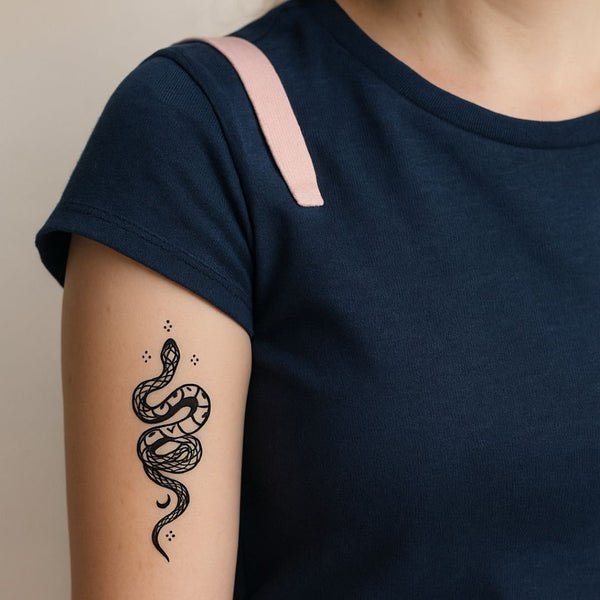
What a snake tattoo actually means
Six readings come up again and again. Most people end up somewhere between two or three of them.

1. Shedding and starting over
The obvious one, and still the most chosen. A snake leaves its old skin behind in one piece and keeps going. People get this one after a breakup, after quitting a job, after coming out of something heavy. It is a stamp on the moment that says the old version is done.
2. Wisdom and reading the room
Snakes miss nothing. They sense movement before they see it. That watchfulness is why the serpent has stood for hidden knowledge and sharp instinct since antiquity. If you are the person who clocks the mood in a room before anyone speaks, this is your reading.
3. Eternity, through the ouroboros
A snake devouring its own tail, closing into an unbroken circle. The ouroboros turns up in Egyptian funerary texts around 1600 BCE, in Greek alchemical manuscripts, in Norse myth as Jörmungandr, the world serpent circling the earth, and much later in Carl Jung's writing. It means eternity, wholeness, and the idea that endings and beginnings are the same event. It is the deepest reading available to you, and it condenses into one very clean shape.
4. Healing and medicine
The Rod of Asclepius, a single serpent wound around a staff, is still the symbol of medicine today. If you work in healthcare, or you have come through a long illness, the snake carries this quietly. Worth knowing so you can choose it on purpose rather than by accident.
5. Protection and good fortune
In Japanese tattooing the snake, hebi, is almost entirely positive: good luck, protection, fierce loyalty. The contrast with the Western reading is stark, and it is one of the reasons Japanese-style snakes are so popular outside Japan. The snake is something you want on your side.
6. Temptation, and the honest caveat
We are not going to skip this one. In the Judeo-Christian tradition, the serpent of Eden fixed the snake to temptation and deceit, and that association is still live in most of Europe. Some people avoid the motif for exactly that reason. Others lean into it deliberately, because a snake can just as easily say do not underestimate me as it can say renewal. Either way, know which reading your audience will land on first.
The snake and reclaimed power
Something has shifted in the last few years, and it is worth its own section.
The snake has been attached to powerful women for millennia: Cleopatra, the goddess Isis, the Minoan snake goddess of ancient Crete, and above all Medusa. None of these are decorative figures. They are figures of authority and danger, and most were framed as threats by the people telling the stories.
Medusa tattoos in particular have become a symbol of reclaimed power, worn especially by survivors of assault. The logic is direct: a woman punished for something done to her, turned into a monster, taken back as a protector. If you are drawn to a snake and you are not entirely sure why, this is often the reason underneath.
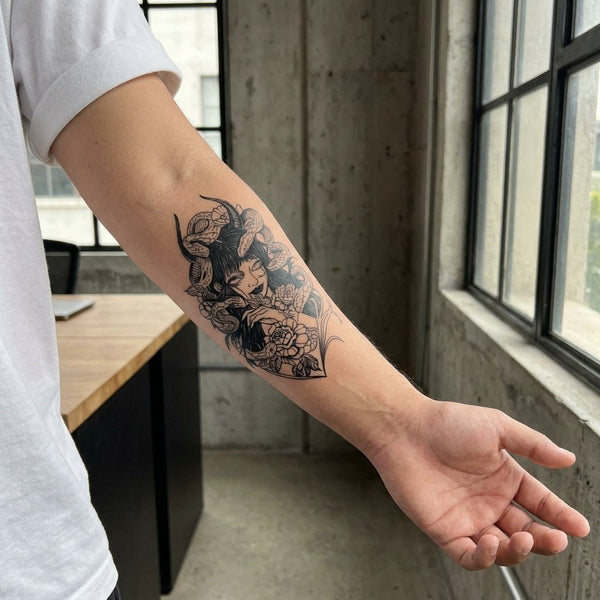
Worn on a woman, a snake is rarely decorative. It usually means something, and it does not apologize for its own intensity.
What you pair it with changes everything
The snake alone is open to interpretation. Add a second element and the meaning locks in.
Snake and rose
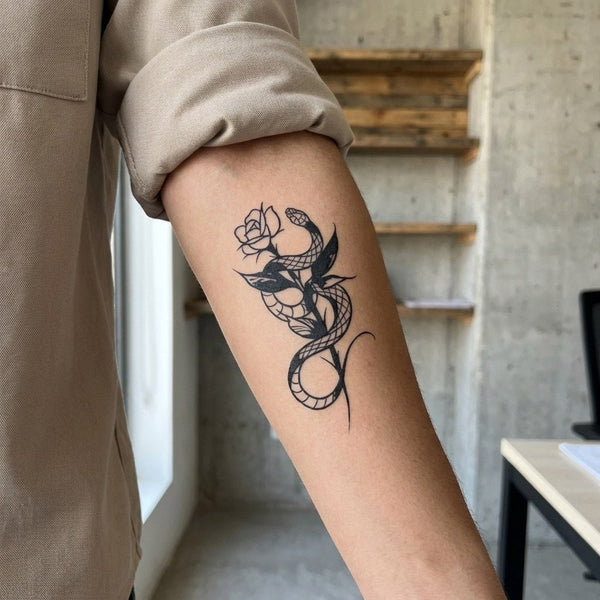
Our most ordered pairing, by a distance. The rose brings beauty and love, the snake brings danger and power. Together: beautiful, but do not push your luck. It suits anyone who has stopped choosing between being soft and being formidable. Looks best on the upper arm, thigh or shoulder, where the coil has room to wrap. Browse the rose tattoo collection for variations.
Snake and fine-line florals
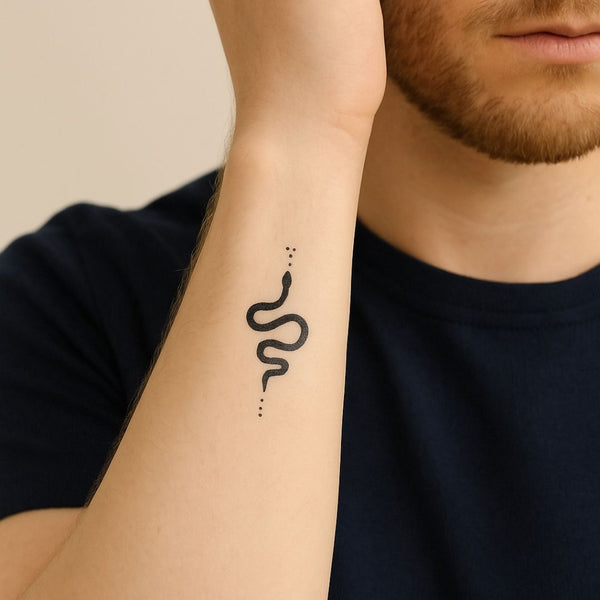
If a rose feels too classic, run the snake through wildflowers, a branch, or a lotus. Same idea, softer register, more contemporary. This is the version that reads well at smaller sizes. See the flower tattoo collection.
Snake and dagger
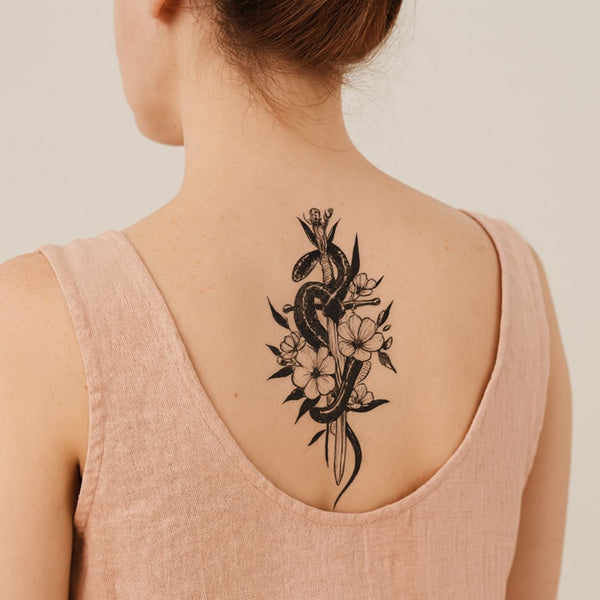
Straight out of American traditional flash, and still one of the strongest compositions in tattooing. A snake wrapped around a blade means cutting something loose on purpose: a habit, a person, a version of yourself. Direct, and hard to misread.
Snake and yin-yang
Renewal meeting balance. The coil around the symbol suits anyone who likes their symbolism tidy and philosophical. Works nicely on the forearm or shoulder blade. See the yin yang collection.
Snake and skull
The darkest of the set, and the most literal: a serpent threading through an eye socket is a memento mori, a reminder that time is running. Raw, and not for everyone. See the skull tattoo collection.
Snake and red spider lily
Less known in Europe, and beautiful. The higanbana, or red spider lily, is the flower of final partings in Japanese tradition, planted at graves and associated with farewells that do not reverse. Paired with a snake, it reads as memory that stays. In jagua it comes out in deep blue-black rather than red, which makes it more somber and, honestly, more interesting. Best on the ribs, thigh or shoulder blade, where the petals have room.
What jagua taught us about snake designs
This part you will not find on other guides, because it comes from our own orders rather than from symbolism books. Five things we have learned from doing snake designs in jagua at volume.
1. Snakes that wrap around a limb fade unevenly. The underside of an arm or thigh rubs against clothing and other skin constantly, so the coil fades faster there than on top. Expect the design to go patchy along the underside first. Not a defect, just anatomy.
2. Fine-line snakes fade two to three days sooner than shaded ones. Less pigment on the skin means less to lose before the design stops reading. If you want the full two weeks from a minimalist snake, put it somewhere low-friction.
3. Thigh wraps need care in the first 48 hours. It is the placement where the design is most likely to smudge before the color has set, because thighs touch each other and touch clothing all day. Loose pants for two days makes a visible difference.
4. Snake and rose outsells everything else. Consistently, month after month, across every market we ship to. If you are torn, that is the safe bet.
5. Snakes work better on deeper skin tones than people expect. The long, continuous lines and strong shapes read clearly where fine filigree would not. If you have been put off by washed-out examples online, a bold snake is one of the better motifs to try.
Where to put it
The snake is a shape that wants length. It looks best where it can follow the body rather than sit on it.
- Forearm. The classic. Enough room for a full body and a head, visible when you want it.
- Spine. A vertical snake down the spine is one of the strongest placements in tattooing. Needs size to work.
- Thigh. The most room of all, and the best home for snake and floral compositions.
- Bicep or upper arm. Natural for a wrap, and easy to cover.
- Hand or fingers. Striking, but the highest-friction area on the body. In jagua expect four to seven days here, not two weeks.
- Ribs and shoulder blade. Discreet, with space for detail. Good for the larger pairings.
Try it before you commit
Snakes are big commitments. They are long, they wrap, and the placement decides whether the design flows with your body or fights it. That is very hard to judge from a photo on a screen.
A jagua snake gives you one to two weeks to find out. Real blue-black, the same tone as a needled tattoo, developing over 24 to 48 hours because the ink stains your skin rather than sitting on it as a film. Wear it through a normal week: work, gym, showers, sleeves. If the wrap sits right and you still love it, take the photo to a tattoo artist. If not, it fades on its own. No laser, no cost, no regret.

Wear the serpent first.
Snake designs in natural jagua ink. Realistic blue-black, 1 to 2 weeks of wear, waterproof, EU cosmetic-certified and PPD-free.
Free shipping over €33 · Ships across Europe in 3-8 days
Once it is on, look after it properly: our jagua aftercare guide covers how to get the full two weeks out of it.
One warning: never black henna
If you are tempted by a snake design on holiday, from a beach stall in Greece, Spain, Turkey or anywhere else along the Mediterranean, do not take the black one. Most street black henna contains PPD, a hair dye chemical that is banned for use on skin across the EU. Reactions can be severe and some people are left with permanent scarring.
Real henna is always brown. Black means PPD. Jagua is deep blue-black, never jet black, and contains no PPD at all. The full story is in our guide to the dangers of black henna.
Frequently asked questions
Is a snake tattoo bad luck?
No. That idea comes from one specific reading, the serpent of Eden in the Judeo-Christian tradition. Almost everywhere else the snake is protective and positive: wisdom and healing in ancient Greece, good fortune and loyalty in Japan, eternity in the ouroboros. What your tattoo means is what you intend it to mean.
What does an ouroboros tattoo mean?
A snake eating its own tail, forming an unbroken circle. It stands for eternity, wholeness, and the endless cycle of death and renewal. It appears in Egyptian funerary texts around 1600 BCE, in Greek alchemy, and in Norse myth as Jörmungandr, the world serpent. It is one of the oldest symbols we still wear.
What does a snake tattoo mean on a woman?
Usually feminine power, intuition and self-possession. The snake has been tied to powerful women for millennia: Cleopatra, Isis, the Minoan snake goddess, Medusa. For many people, wearing one is a way of reclaiming a symbol that patriarchal storytelling turned into a warning, and turning it back into authority.
What does a snake and rose tattoo mean?
Beauty with a warning attached. The rose brings love and beauty, the snake brings danger and power. Together they read as beautiful, but do not underestimate me. It is the most ordered snake pairing in our collection.
Where does a snake tattoo look best?
Anywhere long and flowing, because the shape follows the body: forearm, spine, bicep, thigh, along the collarbone, or wrapping a hand. A coiled snake also works well in a compact circle on the shoulder or sternum.
How long does a jagua snake tattoo last?
One to two weeks, like any jagua design. Snakes that wrap around an arm or thigh tend to fade unevenly, because the underside of a limb rubs more than the top. Fine-line snakes fade two to three days sooner than shaded ones, since there is simply less pigment on the skin.
What is the difference between a snake and a Medusa tattoo?
A snake tattoo is the animal and its symbolism: renewal, wisdom, protection. A Medusa tattoo is a specific figure, and in recent years it has become a symbol of reclaimed power, particularly among survivors of assault, who wear it to turn a story of blame into one of protection. Related, but not interchangeable.